Spanish bureaucracy uses a cluster of similar looking acronyms, and it is easy to confuse them. NIE, NIF, DNI and TIE all relate to identity or tax, but they are not the same thing. This guide sets each one out in plain English so you know which applies to you.
What is an NIE?
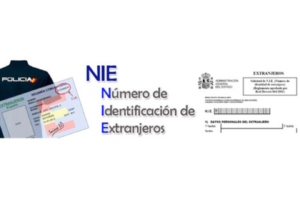
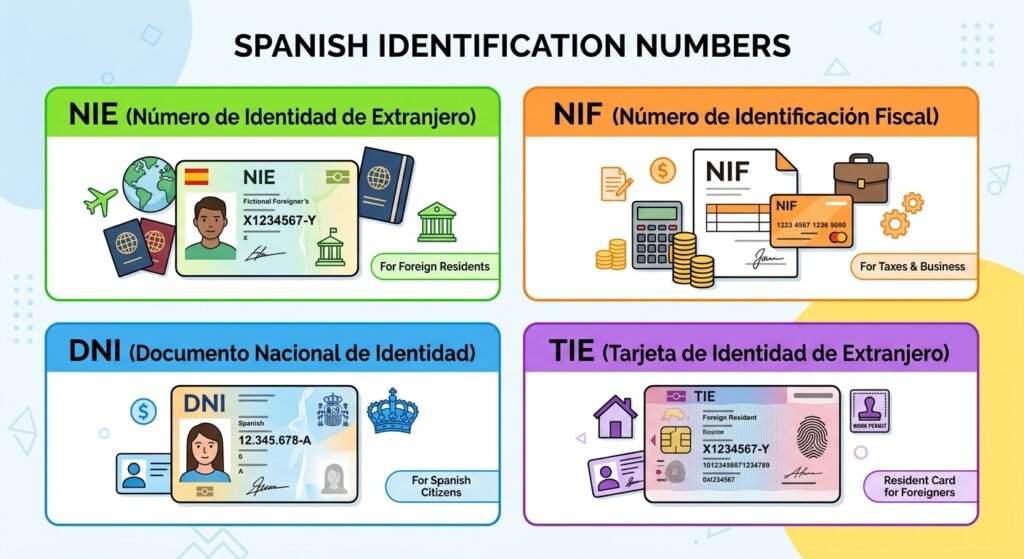
The NIE, the Numero de Identificacion de Extranjero, is the identification and tax number issued to foreign nationals. It is the number a foreigner uses for almost every official act in Spain, from buying property to paying tax. It is a number, not a card, and it does not by itself grant the right to live in Spain.
What is a DNI?
The DNI, the Documento Nacional de Identidad, is the equivalent for Spanish citizens. It is both a number and a physical national identity card. Foreigners do not receive a DNI.
What is a NIF?
The NIF, the Numero de Identificacion Fiscal, is the tax identification number used for dealings with the tax authorities. For a Spanish individual the NIF is effectively the DNI number, and for a foreigner the NIF is effectively the NIE number. Companies have their own NIF. In everyday use, a foreigner’s NIE and NIF are usually the same figure seen in two contexts.
What is a TIE?
The TIE, the Tarjeta de Identidad de Extranjero, is the physical residence card issued to non EU citizens who have the right to live in Spain. It carries your photo and your NIE number and proves your residence status. The key distinction is that the NIE is the number, while the TIE is the card that a resident non EU national carries.
How they relate: a quick reference
- NIE — a number for foreigners, used for tax and official acts.
- NIF — the tax role of that number; for a foreigner it equals the NIE.
- DNI — the Spanish citizen equivalent, a number and a card.
- TIE — the physical residence card for non EU residents, showing the NIE.
Which one do you need?
If you only need to transact in Spain, buying a property or opening a bank account, the NIE is enough, and a expert NIE service can secure the number that everything else is built on. If you are a non EU national settling in Spain, you will likely need both the NIE and, later, the TIE. For the distinction that trips people up most, read the key differences between an NIE and a TIE. It also helps to understand how long your Spanish NIE stays valid and how to verify your NIE status in Spain once it is issued.
Frequently asked questions
Is my NIE the same as my NIF?
For a foreign individual, yes. Your NIE number serves as your NIF for tax purposes.
Do I need a DNI as a foreigner?
No. The DNI is for Spanish citizens. Foreigners use the NIE.
Is a TIE the same as an NIE?
No. The NIE is the number; the TIE is the physical residence card that displays it for non EU residents.
Does everyone need a TIE?
No. Only non EU nationals with residence rights need a TIE. Many people only ever need the NIE.
Which one do I get first?
The NIE. It is the foundation number that the NIF role and, where relevant, the TIE card build upon.